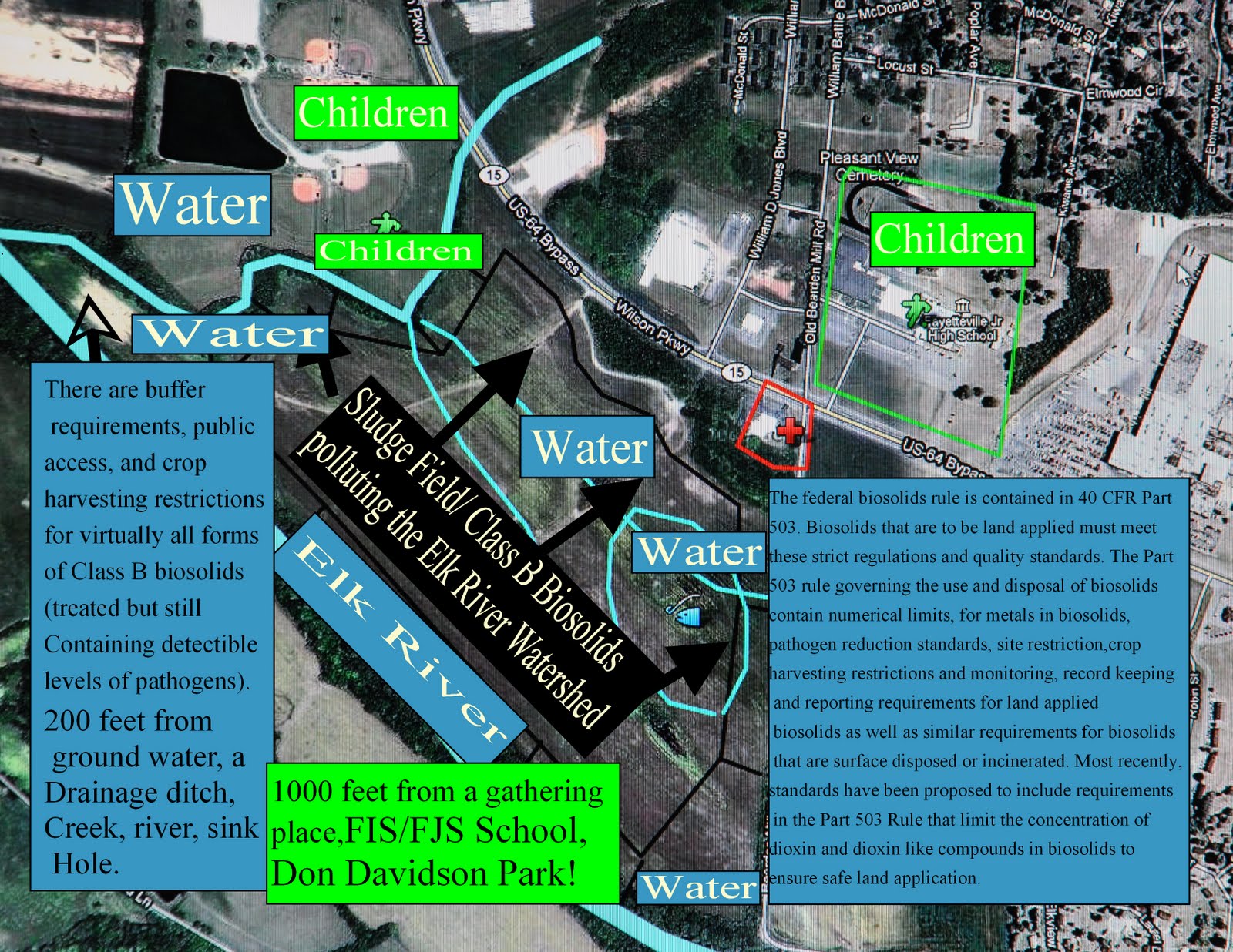
The Clean Water Act required that this regulation protect public health and the environment from any reasonably anticipated adverse effects of pollutants and pathogens in biosolids.
Federal regulations require that state regulations be at least as stringent as the Part 503 Rule. The underlying premise of both the federal and state regulations is that biosolids should be used in a manner that limits risks to human health and the environment.
Land application of biosolids involves some risks, which are addressed through federal and state regulatory programs. Pollutants and pathogens are added to soil with organic matter and nutrients. Human and animal health, soil quality, plant growth, and water quality could be adversely affected if land application is not conducted in an agronomically and environmentally sound manner.
Site suitability
Federal, state, and local regulations, ordinances or guidelines place limits on land application based on site physical characteristics that influence land application management practices. These include topography; soil permeability, infiltration, and drainage patterns; depth to groundwater; and proximity to surface water.
Potentially unsuitable areas for biosolids application include:
• areas bordered by ponds, lakes, rivers, and streams without appropriate buffer zones
• wetlands and marshes
• steep areas with sharp relief
• undesirable geology (karst, fractured bedrock) if not covered by a sufficiently thick layer of soil
• undesirable soil conditions (rocky, shallow)
• areas of historical or archeological significance
• other environmentally sensitive areas, such as floodplains
http://www.mawaterquality.org/capacity_building/mid-atlantic%20nutrient%20management%20handbook/chapter10.pdf
Land Application Sites were selected to avoid streams and riparian areas. In addition, the vast majority of
trees present on the application sites form the border of each site and are of the mature hardwood variety
and do not typically produce loose bark or exfoliate. For the most part, trees are allowed to grow
undisturbed. Trees that die are allowed to remain in place or where they fall and are only removed if they
happen to fall over an site access roadway. Accordingly, DOE staff concludes that the activity would be
unlikely to adversely affect the endangered Indiana bat. The reasons for our conclusion are:
• the rarity of the Indiana bat species on the ORR;
• the land application sites are not located in designated floodplains;
• the absence of streams present on the application sites, reducing the likelihood of foraging
habitat;
• the absence or rarity of exfoliating tree stands that are present or serve as the borders to
application sites, reducing the likelihood of roosting habitat;
• the non-disturbance of existing tree stands by the current operations (e.g., lack of tree removal
operations), reducing the likelihood of roosting disturbance if the Indiana bat is present;
July 2002
J-14
• the established buffer zone of 500 feet around existing bodies of water on the application sites
prohibiting the application of biosolids, reducing the likelihood of direct or indirect contact with
biosolids being applied if the Indiana bat is present; and
• the rigorous radionuclide monitoring program in place and the extremely low to non-detectable
levels of radionuclides found in application site soils (Table 1.3) and vegetation (Table 1.4),
reducing the likelihood of accumulation of radionuclides within insects that consume vegetation
that represent a food source for the Indiana bat.
http://nepa.energy.gov/nepa_documents/ea/EA1356/appendixJ.pdf
http://sludgefield.blogspot.com/